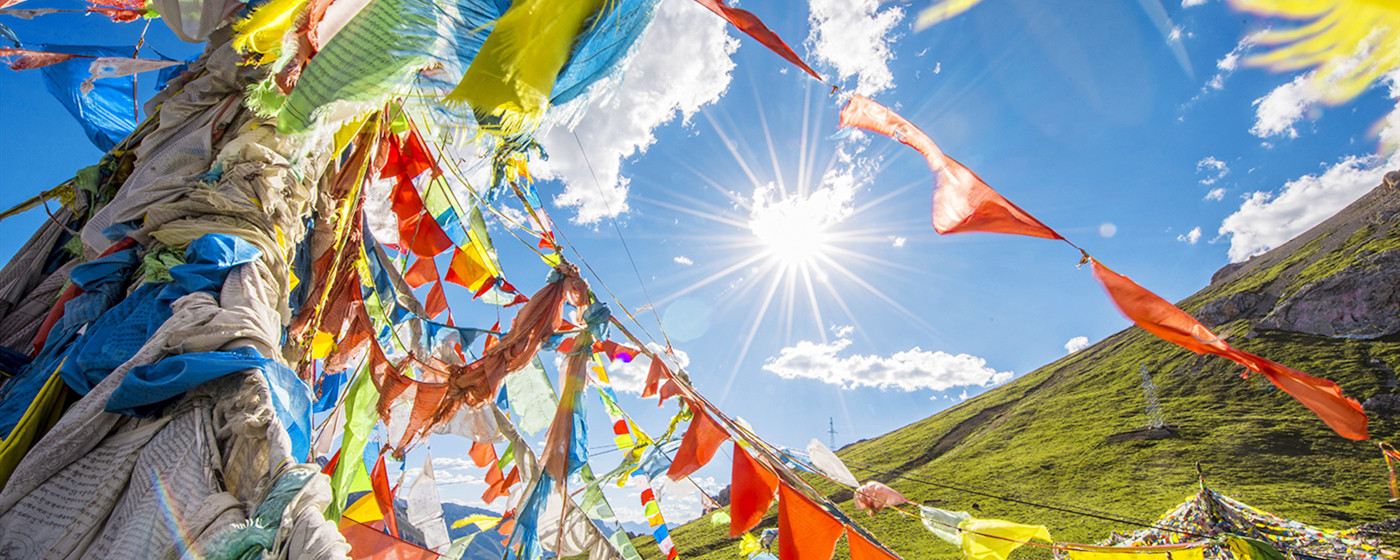

Discover the symbolism and spiritual significance of these colorful flags that flutter in the mountain winds, stitching the skyline of Tibet into a living tapestry of faith. To see them is to witness a dance between the earthly and the divine: strips of blue, white, red, green, and yellow, strung across valleys, rooftops, and sacred sites, their edges frayed by storms and time. But these are no mere decorations—they are whispers of a culture where every breath of wind carries a prayer, and every color holds the weight of centuries.
The Interwoven Five Colors: A Code of Nature and Faith
The arrangement of the five-colored prayer flags is a reflection of heaven and earth. The topmost blue mirrors the boundless Tibetan sky, under which nomads once herded stars; white represents floating 祥云 (auspicious clouds), embodying the Bon religion’s reverence for the celestial realm; red symbolizes the eternal flame, reflecting Buddhism’s warmth of compassion; green signifies the flowing rivers, nourishing 高原 (highland) life; yellow is the earth’s 肌肤 (skin), nurturing barley and hope. This order is inviolable, like mountains that cannot invert or rivers that cannot reverse—it is the Tibetan ancestors’ homage to nature and their 敬畏 (reverence) for the five elements: earth, water, fire, wind, and space.
In an old teahouse on Lhasa’s Barkhor Street, Tibetan 阿妈 (elderly woman) Tsering told me, “Every color is a speaking scripture.” The Bon tradition believes blue belongs to heaven, white to clouds, and red, green, yellow to earthly elements, corresponding to the abodes of deities in the three realms. Buddhism infuses deeper 禅意 (Zen philosophy) into the colors: blue for emptiness, white for wind, red for fire, green for water, and yellow for earth, with five wisdoms pacifying greed, anger, delusion, pride, and doubt. This 融合 (fusion) mirrors Tibet’s cultural essence: the Bon’s nature worship and Buddhism’s philosophy of compassion woven into a 共生 (symbiotic) code on the flags.
The Soaring Wind-Horse: From Bon Altars to Wings of Faith
Prayer flags trace their origins to the Bon ritual “lungta” (wind horse). Before Buddhism’s arrival, plateau herders revered horses as steeds of the 山神 (mountain deities), offering wooden horse statues to appease them. When Buddhist mantras met Bon 图腾 (totems), the horse’s back carried the “Three Jewels” symbol, with four corners painted 大鹏 (garuda), 龙 (dragon), 狮 (lion), and 虎 (tiger). The garuda pierces ignorance, the dragon subdues floods, the lion guards the earth, and the tiger 威慑 (deters) evil. Printed on colorful paper, these images were cast toward mountain peaks by believers, like messengers soaring to the divine.
At the cliffs of Lake Namtso, I witnessed an old man scatter lungta: hands 合十 (joined), he raised the papers overhead, murmured prayers, and released them. The wind carried the lungta like a flock of colorful birds, 掠过 (sweeping over) the holy lake into the cloud shadows of Nyenchen Tanglha. “Each lungta is a letter to the mountain god,” he said. “The wind carries blessings to the farthest corners.” This 质朴 (simple) 浪漫 elevates prayer flags beyond religious rituals, transforming them into verses of dialogue between humanity and nature.
The Tuo Sui Ceremony: When Faith Illuminates Daily Life
On auspicious days after the Tibetan New Year, rooftops across Tibet resound with the joyous chants of “Tuo Sui.” Families don traditional 藏袍 (Tibetan robes), replacing faded flags with new five-colored strips. Children hang banners from benches, elders mark auspicious patterns with 糌粑 (barley flour), and 主妇 (housewives) 煨桑 (burn incense) to 祈福 (pray for blessings). The smoke of cypress mingles with fluttering flags, ascending together. This is not superstition but a celebration of life—just as flags fade and life cycles, blessings remain ever fresh.
In a Gongbu Tibetan village in Nyingchi, I participated in a Tuo Sui ceremony. Elderly village chief Tsering Dorji pointed to the flagpole on the roof: “These willow branches are last year’s; we replace them with new ones. Like barley growing again after harvest, 苦难 (suffering) passes, and blessings return.” His words revealed another secret of prayer flags: they embrace impermanence, weathering wind and rain until their colors fade to near-natural gray, then quietly retire. This acceptance of “impermanence” embodies Tibetan wisdom—the essence lies not in vibrancy but in each flutter, carrying sincerity toward the sky.
The Wind’s Chants: Modern Echoes of Prayer Flags
Today, prayer flags still wave along highways, monasteries, and village rooftops. Tourists photograph their vivid hues but often overlook the Tibetan scriptures. The 密集 (dense) “Om Mani Padme Hum” are not decorations but 流动 (flowing) mantras. Herders believe each rustle is a 诵念 (recitation); travelers tie flags for family blessings; even infants are held by parents to touch flagpoles, 感受 (absorb) the wind’s blessings.
On the Kailash Kora pilgrimage route, a prostrating pilgrim told me, “Prayer flags are tireless reciters. When we weary, the wind chants for us.” This struck me—while urbanites chase “eternity” and “efficiency,” Tibetan flags teach us: faith can be slow, entrusted to wind, seasons, and endless reincarnation. Those faded flags are Tibet’s love letters to time.
Epilogue: The Wind as Messenger
Standing at 米拉山口 (Mila Pass), the 5,000-meter wind whips the five-colored flags into a thunderous roar. 远处 (In the distance), mani stone mounds 刻满 (carved with) six-syllable mantras, and pilgrims’ prayer wheels never cease. The meaning of prayer flags lies not in the flags themselves but in the 时空 (space-time) they weave—the blue sky as canvas, wind as brush, each banner-hanger a painter, writing 眷恋 (attachment) to the land, 慈悲 (compassion) for all beings, and 释然 (reconciliation) with impermanence.
Next time you see prayer flags, pause and listen to the wind. It is Tibet’s heartbeat, the whispers of millennia, and the tenderest wishes of countless ordinary souls: may mountains and rivers be serene, all beings find peace, and every breeze carry away a trace of suffering, bringing dawn’s light.